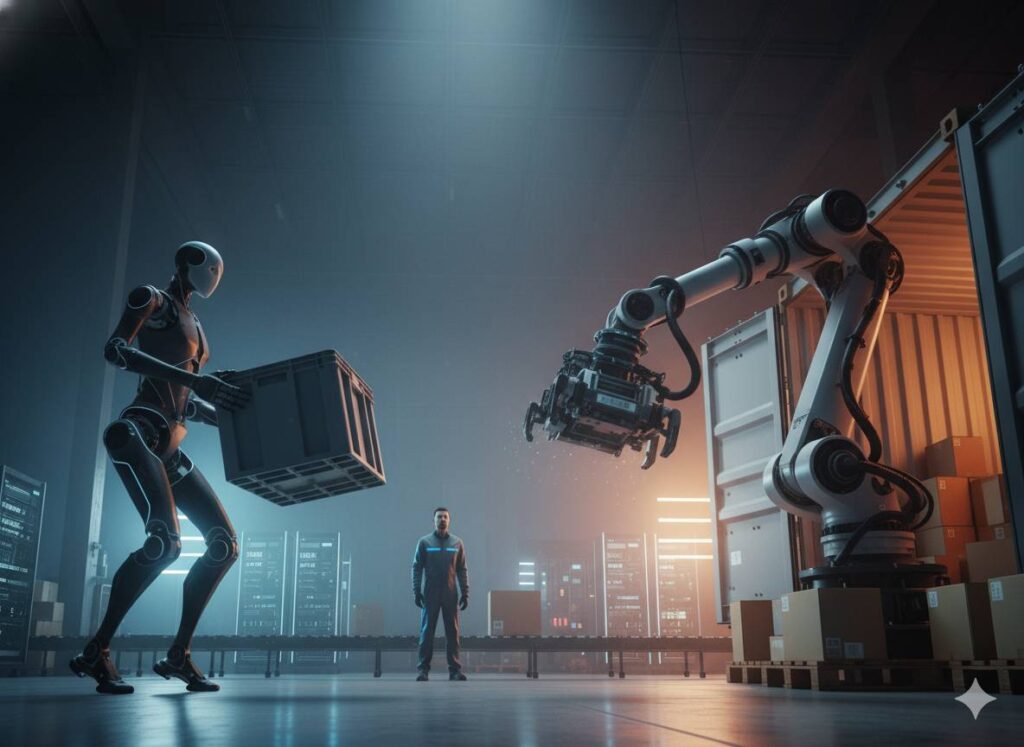
Visit a contemporary fulfillment center. You will be witnessing a cacophony of whirling machines. Yet there is a bottleneck, which is very critical. The last frontier is the movement of unorganized objects in shelves to conveyor belts. This last 10 feet issue is the battle field of billions of dollars. And there is a silent battle between two giants of robotics that is determining its future.
On the one hand, there is Amazon, the logistics giant, and its two-legged robot, Digit. Beyond that, there is the mythical Boston Dynamics that uses its arm-based robot, Stretch. It is not just a competition of products. It is a basic collision of work-related philosophy in the future.
The Competitors: A Story of Two Designs
The essence of this dispute is in the fact that their blueprints are radically different. All designs demonstrate a unique perspective of automation.
The Generalist: The Digit of Amazon
Suppose you had a robot, which moves like yourself. Digit is about five feet nine inches in height. It walks on two legs. It is able to cower and pick up things. Its anthropomorphic shape is an intentional decision.
Amazon imagines a scenario whereby the robots will be in operation inside human-friendly space. Narrow aisles and stairs are not an issue. This universality method is geared towards maximum flexibility. The target is to have a machine that will unload a truck and pick things and palletize boxes.
The Specialist: Boston Dynamics’ Stretch
Imagine, now, a machine that was constructed to do one thing, and that it has perfected. Stretch has a large arm which is very powerful and has a mobile base. It has a sophisticated vacuum gripper. The design does not at all have a human like form.
Boston Dynamics concentrated on one, expensive issue. That is the issue of truck unloading. Stretch is an expert, a professional in its sphere. It focuses on pure speed and unremitting stamina as opposed to versatility. This is optimization at the extremist level.
The Battlefield: The Hard Data and Deployment
Theories are examined at the loading dock. It is the real world outcomes that count. The two companies are testing their ideas in challenging conditions.
Amazon’s Insider Advantage
Amazon is implementing Digit in its tremendous empire. This is the final place of testing. They have an opportunity to add Digit to the current fleet of more than 750,000 robotic drive units. According to a report by The Robot Report, early pilots have Digit performing repetitive duties. This involves the transportation of empty totes of robotic shelves.
The strategy is long-term. They are gambling on the volume to reduce the costs. One of the engineers said, “We are constructing the warehouse in 2030 and not in 2023.
The Boston Dynamics B2B Blitz
In the meantime, Boston Dynamics is achieving big wins with third party logistics industry heavy weights. An example is DHL Supply Chain, which ordered Stretch robots in the amount of 15 million. They have a multi-year international implementation.
The value proposition is direct and overwhelming. Stretch has the capacity to deload a truck within less than 45 minutes. The human crew requires a lot of time, especially 90 minutes or so. It is not a vision, but a spreadsheet calculation. One of the DHL executives once said, the ROI of decreasing the unload time is indisputable. Stretch delivers that today.”
The Strategic Fault Lines: Agility vs. Optimization
Competition brings out a more fundamental competition gap. Is the future flexible machines or ideally designed equipment?
Digit is a case whose argument is agility. Warehouses are dynamic. Product mixes change daily. Such a generalist robot which can be redeployed as a receiving robot to a packing is invaluable. It makes the operation future-proof.
On the other hand, the Stretch case is one on pure optimization. The majority of the warehouse expenses are associated with certain, inhuman tasks. What is the point of creating Swiss Army knife when you require a scalpel? Stretch is a painkiller of the most expensive kind.
A Real-World Analogy: The Kitchen Showdown
Think of it like this. Stretch is an international quality espresso machine. It prepares one thing in an ideal manner, quicker than any barista. Digit is however, an all round chefs knife. It is capable of chopping, slicing and dicing practically anything. Do you develop a coffee shop or a full kitchen? This question entirely depends on what you are going to be serving in the next decade.
Specialist Knowledge: The Scalability Calculus
We must look beyond the specs. The actual struggle is one of economics and size.
One supply chain analyst was recently interviewed by me and has visited both deployment locations. It is an interesting story, she observed. Amazon is competing in a 10-year game, where it is wagering that it can make the generalist affordable. Boston Dynamics is offering a high-end remedy to an issue that corporations are frantic about addressing at the moment.
She added a crucial point. The wildcard is intelligence. Is the focused AI of Can Stretch adaptable? Is the overall structure of the Digit ever any more efficient than a professional? That company which breaks that code takes the whole supply chain.
Conclusions: More Than Machines
The consequence of this war will create our world a lot more than warehouses.
When the vision of Digit is won, humanoid robots make us more comfortable. We would find them in the shops, the hotels and even at our homes. The machine fits our world.
Yet, when the vision of Stretch is used, then it strengthens an alternative future. Task-specific alien robots will be populated in our world. They will not resemble us, but will excel us in finer spheres. Our world will be adjusted to their higher, specialized productivity.
The next time you get a package delivered within record time, you should also remember the battle that was being fought unseen to allow it to be delivered. Whether it is a question of whether or not robots will operate our logistics, it is now a question of what form they will assume. And the choice of that, a helper anthropomorphic in our likeness, versus a tool that was constructed to serve pure purpose and not anthropomorphism, is on the battlefields today. One box at a time.

