Think of the old-fashioned clumsy robots, which were only programmed to perform one thing? They’re getting a new brain. AI Robotics is experiencing a revolution. It enables machines to do things which they have never witnessed. This is zero-shot learning. It is transforming the whole automation.
The Old Bottleneck: The Rise of Robots Fell.
Conventional robots are brilliant experts. They excel on a factory line. However, alter a single minor factor, and they become unsuccessful. Such rigidity was a result of their training. The engineers were forced to code all the possible cases. This was time consuming and costly. It simply didn’t scale.
The gap was the real problem of Sim2Real. In an ideal digital simulation, a robot may be able to master a task. But actual friction and shadows of life disorientated it. We were hard to get started on machines, not intelligent partners. Robotics required a change of paradigm.
The New Paradigm: The Cloud-based Common Sense
Surprisingly, the breakthrough came in an unexpected place that was internet-scale data. New models do not process text and images in raw motion data as well. They are taught such concepts as heavy, fragile or even hot. This forms some kind of common sense on machines.
The RT-2 model of Google is an innovation in this regard. It is a vision-language-action paradigm. Basically, it relates cognition to bodily act. This base enables robots to have on-the-fly reasoning. They do not simply remember, they deduce.
An Experiment in the Real World: the Dinosaur Case
Take a powerful example of one of the demos of Google DeepMind. One of the robots was questioned, “Take the extinct animal. Among other objects on the table was a dinosaur toy. This command was something that the robot had not practiced. It was able to select the dinosaur.
How? Its AI model knew that extinct was semantically related to dinosaur. It put such knowledge into a successful action. This is zero-shot in action. It represents an AI new world.
Expert Advice: Programmer to Coach
I interviewed a systems engineer of one of the top labs. She outlined the radical transformation of her work. “We’re no longer programmers. We are getting coaches of such systems, she said. Her team has now presented high level goals. The AI Robotics system calculates the exact movements by itself.
This is a transformation to the economics of deployment. All of a sudden, one technician will be able to operate a varied fleet of robots. There are tasks which are unique and unpredictable in each machine. This was inconceivable five years back.
The Warehouse Helper Case Study
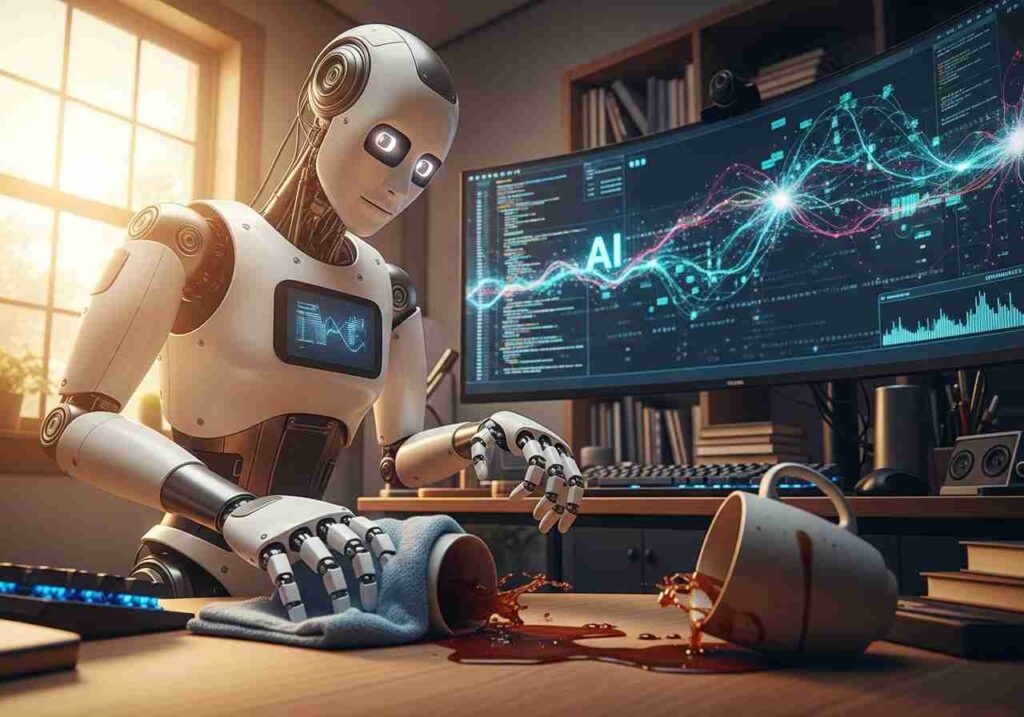
The logistics warehouse has a humanoid robot. Its first order is only to keep this place tidy. One of the boxes falls, and drops bits. It would be disregarded by an old robot or halted. The mess is visualized by the new AI-powered machine. It comprehends that tidy is an act of cleaning up. It locates a vessel and gathers the components. And all without one line of business code.
This isn’t science fiction. It is currently being proved by such companies as Figure AI. Their humanoid robot is now able to have complex and unscripted conversations. It interprets natural language high-level goals. The influence of foundation models in play.
The Tech Behind the Magic
How does this actually work? It is a process of data and inference, a multi-step process.
- Visual Perception: The cameras of the robot record the scene.
- Semantic Understanding: The AI model is used to recognize objects and their connections.
- Goal Inference: It transforms a human command into a physical goal.
- Action Generation: It involves developing a series of actions which lead to the achievement of the goal.
This is done almost immediately. It becomes possible due to the training of massive datasets by the model. It is a distinction between to know answers by heart and to have the principles.
The Hurdles We Can’t Ignore
Naturally, it is not the smooth sailing. There are still major challenges with these systems.
The physical world is complicated with regard to common sense. It is one thing to know that a glass is full. Another one is the fluid dynamics as it is being transported. There are also long-horizon tasks, which are hard. A hundred and thousand micro-steps and possible failures are involved in preparing a meal.
Moreover, the main priority is safety. What can we do to ensure safe decision-making by a general-purpose robot? It is a critical open question to the whole industry.
A Personal Prospectus on the Future
The transformation is felt after observing this field over the years. We are getting past the era of the specialist robot. We are going into the age of the generalist machine. The move is analogous to that between serious calculators and the first general computers.
The potential is staggering. Consider one platform of humanoid robots. It may be a factory employee one day. Then, an assistant at home the next. Its working would be based on software rather than its hardware. It is this flexibility that is the real potential of modern AI Robotics.
Summary: An Appeal to Cautious Optimism
So, where does this leave us? Learning and adaptation is no longer a dream in the ability of robots to adapt and learn immediately. It is an emerging fact in laboratories and pilot projects across the globe. This requires a novel dialogue.
We should not focus on our technical capability and be pure in our ability but rather we need to be responsible in the way we integrate. It is no longer the question of the possibility to build it. These are the questions of ethics, safety and impact on society. Our world will be redesigned with this technology. We should make sure that we are creating the future in which we want to live.