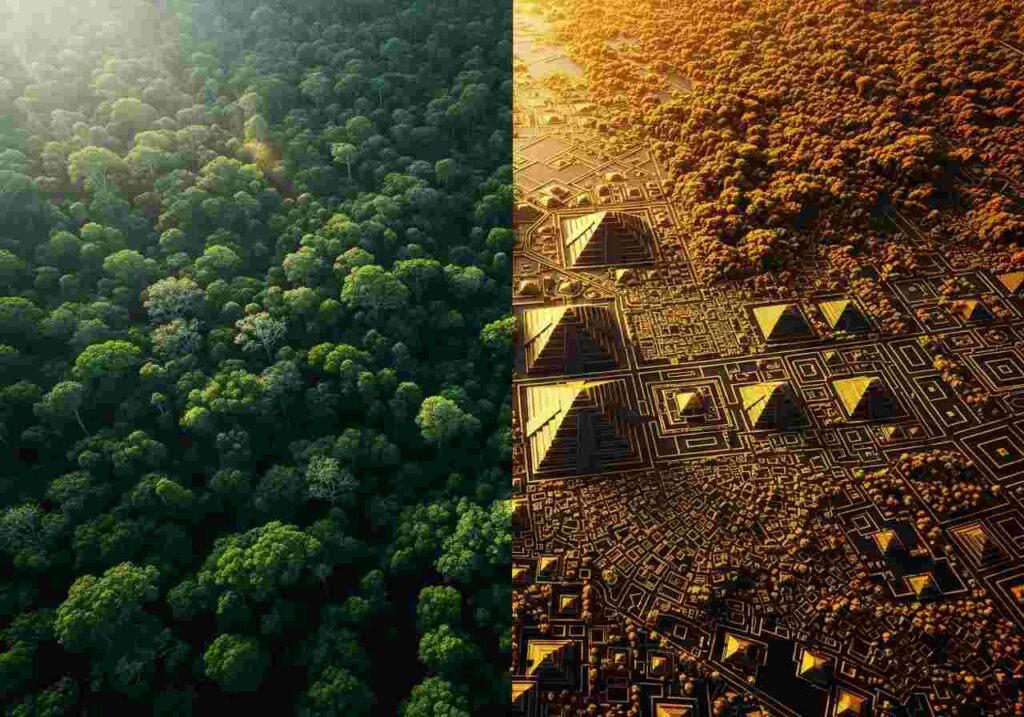
Think of being on an aircraft flying through an jungle that is huge and impenetrable. The one below is a green sheet. Then all at once your equipments show a vast old metropolis underneath. This isn’t science fiction. It’s the power of Lidar. This technology is literally redefining the history of human civilization in the present. We are going through a golden age of discovery and the discoveries are spectacular.
A Cut through the Green Veil
How does it work? Lidar could be termed as a digital machete. It directs millions of laser pulses of the ground in an aircraft. These pulses penetrate the most minute holes in the leaves. Then, they bounce back. All the vegetation returns are eliminated by sophisticated software. What is left is an exquisitely rendered map of the naked earth in 3D. It is a unveiling of all that is beneath.
This discovery tool is massive as explained by Dr. Elena Moss who is a geospatial archaeologist.
“In a single LiDAR survey in Guatemala we were able to find more than 60,000 unidentified structures. It was, as it were, a newly discovered continent.”
A Maya Megalopolis Revealed
Guatemala Peten Jungle was regarded as a difficult place where ancient people could live. Big populations appeared unattainable in the thick bushes. Next was the PACUNAM LiDAR Initiative. The survey information showed an outrageous fact. It depicted a huge interwoven web of cities, farms and castles. This finding indicates that the Maya people were not in thousands but in millions.
They also controlled their surroundings in a very sophisticated manner. They constructed elaborate irrigation canals and agricultural terraces. This discovery entirely breaks our ancient perception of some kind of a lost civilization that just fell. In its place we are shown the strong, multifaceted society which changed its world.
The Amazon’s Garden Cities
For centuries, people have considered the Amazon a pure wilderness. Archaeologists believed it had remained mostly undeveloped by human civilization. Now, Lidar is destroying that myth. Researchers in Bolivia in the Llanos de Mojos area made an impressive discovery. They discovered the traces of the Casarabe Culture. This civilization established a system of city settlements in the period between 500 and 1400 AD.
These were not mere small villages. They were tied together garden cities. They had massive ceremonial centers and intricate web system of causeways and reservoirs. The landscape was not wild. They were designed meticulously and were designed and operated by its inhabitants throughout centuries. The identification causes the reality of the wild Amazon to entirely re-evaluate itself.
The Groundwork of Data to Discovery
Naturally, the online map is not the end. The magic actually occurs when the archeologists strike the ground. With accurate GPS positioning, they will be capable of walking at a target straight. I have observed teams discovering one platform mound in a few hours using Lidar maps. That very search would have required a whole season of hard surveying before.
This performance is ground breaking. It enables the researchers to pose quality questions at the beginning. They are able to explore the trends of trade and war in the regions. They are able to learn about old water management systems in totality. It is not about discovering a location; rather it is about comprehending the community that created it.
A Double-Edged Sword
This is a potent tool, though it has grave ethical issues. The elaborate maps which scientists use to reach such places might also be used by looters. This newly exposed cultural heritage is a pressing and escalating issue that needs protection. Moreover, such findings have significant implications on contemporary indigenous society.
The data often confirms their ancestral roots to the land. They may use this as an effective weapon in land rights claims. The ownership of this knowledge and the beneficiary of such discoveries are also quite complicated. There should be close cooperation and sensitivity in navigating this new ground.
Close: A New Map to an Old World
And this is one of the most exciting times in the discovery of archaeology. Our telescope on the past is Lidar. It demonstrates that the ancient world was much more interconnected, much more populated, and clever than we have ever thought. The lost cities that we idealize were the centers of controlled and prosperous landscapes.