Mars is charted more closely than the ocean floor of our world. Isn’t that a stunning thought? We are desperately hunting the evidence of other worlds life when an alien world is bursting with clues to life right here in our own. It is not merely a question of scientific interest. The secrets at the deep blue contain instant, strong secrets in solving our planetary crisis. The competition to discover this last frontier is no longer an option. It is an urgent protection of the climate crisis.
The Silent Weather machine of the Ocean
We tend to conceptualize the climate crisis atmospherically. Imagine smokestacks and ice caps that are melting. But they do the real work behind the scenes. Our planet has the most potent climate regulator which is the ocean. It has taken up more than 90 percent of global warming excess heat. Human consumption of this resource also produces a significant amount of carbon dioxide, accounting for almost a third of the global total.
The cost of this service is deplorable. The sea is currently warming in an alarming rate. In a 2023 study, the average level of surface temperature in the sea was the highest. It reached a shocking 21.1degC. This heat is contributing to the empowerment of supercharged storms and interference of the important currents. The fact that the ocean is at all guarding us is itself being undermined. These occurrences are hidden and we need to know them to determine our future.
- According to Dr. Sylvia Earle, who is an oceanographer, she states that the ocean forms the foundation of our life support system. Fighting climate change but overlooking the deep sea is like a physician treating a patient but not taking into consideration his heart and lungs.
Vents, Sponges, and Vaults of Carbon
The natural technologies are astonishing, which has been discovered in the recent deep-sea exploration. Deep-sea chimneys are referred to as hydrothermal vents. They host the existence of uniqueness lifeforms that cannot survive on sunlight but rather on chemicals. Microbes here are now being studied by scientists. These are methane and carbon consumers. They have the potential of catalyzing novel capture of carbon. This is a find that provides a guiding template to geoengineering.
In the meantime, plain sea animals are becoming very strong allies. Take the humble sponge. Bed of sponges are huge, biotic reservoirs of carbon. They use the water to get carbon then use it to construct their bones. When they expire, the carbon is buried on the seabed, where it remains unfree during millennia. Preservation of these ecosystems is not an issue anymore. It is a strategic environment move.
Blue Carbon: The Mangrove Miracle Case Study
This is something to consider a potent real-Life example. Coastal wetlands capture blue carbon, a game-changing process. Scientists observed this potential in an Indonesian project. Indonesia is endowed with mangroves. These trees absorb a total of four times higher amount of carbon than tropical rainforests.
Mangroves are also being replanted by the local communities. Their work is eligible to earn them carbon credits. This capital enhances their lives. It also reinstates a natural storm protection. This forms a virtuous economic and environmental wellbeing cycle. It demonstrates that natural solutions to climatic problems can be the best. They do not work against the systems of the planet.
Deepwater Horizon Listening Posts
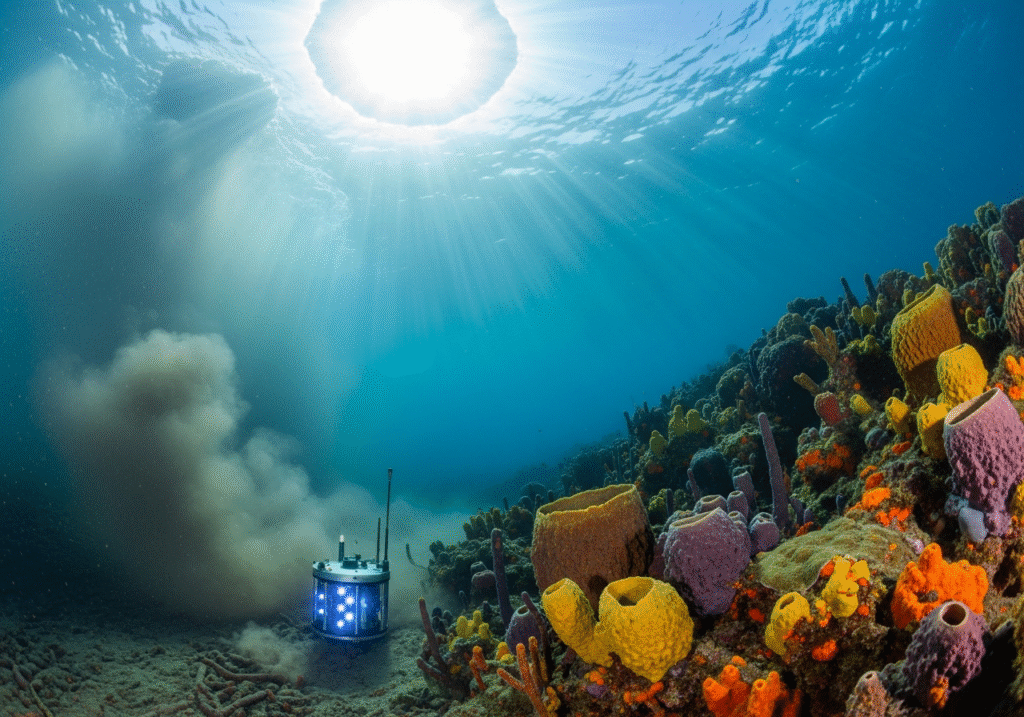
What are the vital signs of the ocean? There is a world system of silent watchmen. The seafloor has arrays of sensors that are used to monitor the temperature, acidity, and currents in real-time. An example of this is the Ocean Observatories Initiative where live data is broadcasted in the Atlantic. This early warning system is called this discovery network.
This data was an important revelation in 2023. It indicated a great deceleration of a large Atlantic current. This climate control system governing the climate in Europe is weaker than it has ever been in a thousand years. Its possible failure would be disastrous. This finding provides us with a golden opportunity. Now we are able to be ready about the dramatic changes that can succeed.
The Deep Sea Mining Dilemma
The search of climate solutions results in new ethical dilemmas. A good example is the finding of rare mineral deposits in the seabed. Green technology depends on cobalt, nickel and manganese. These nodules that are as large as potatoes cover extensive plains in the Pacific. Exploitation of them would be able to feed our batteries.
But at what cost? These abyssal plains are also the biodiversity hotspots. The weird life there only is at this time beginning to be cataloged. These delicate ecosystems would be destroyed through mining. They would produce huge columns of sediment. The full impact is unknown. This brings a hard question to ask. Is it to save another natural system that we must destroy it? The answer is far from clear.
- There is a policy expert of The Ocean Foundation, who says: Deep-sea mining is a huge gamble. We might be swapping one existential crisis with another, and all on a finding of which we do not quite comprehend the nature.
Your Communion with the Unseen World
Thousands of miles may be between you and the coast. But the wellbeing of the ocean is your own. The sea regulates the rain which waters your food, the air that you breathe, and everything. Its weakness being revealed is a wake-up call to all. What goes deep does not remain in the deep.
So, what can you do? Fair play in favor of sustainable seafood. Limit the use of plastic. Promote effective marine conservation zones. And above all, be informed. The greater the ocean value, the greater the investment in ocean discovery and protection. It is not a fringe length scientific endeavor. It is an international survival need.
A Final, Unsettling Thought
The unfamiliar continually frightens us. We are afraid of those depths in the dark and what they may conceal. But it is not what the ocean contains that is really scary. It is our own ignorance of it. Our greatest finding at this point is a change of mind. We cannot use the sea as a distinct and remote object. It is the throbbing heart of the world. And there that heart is straining now. The most immediate way of securing ourselves is to secure it.