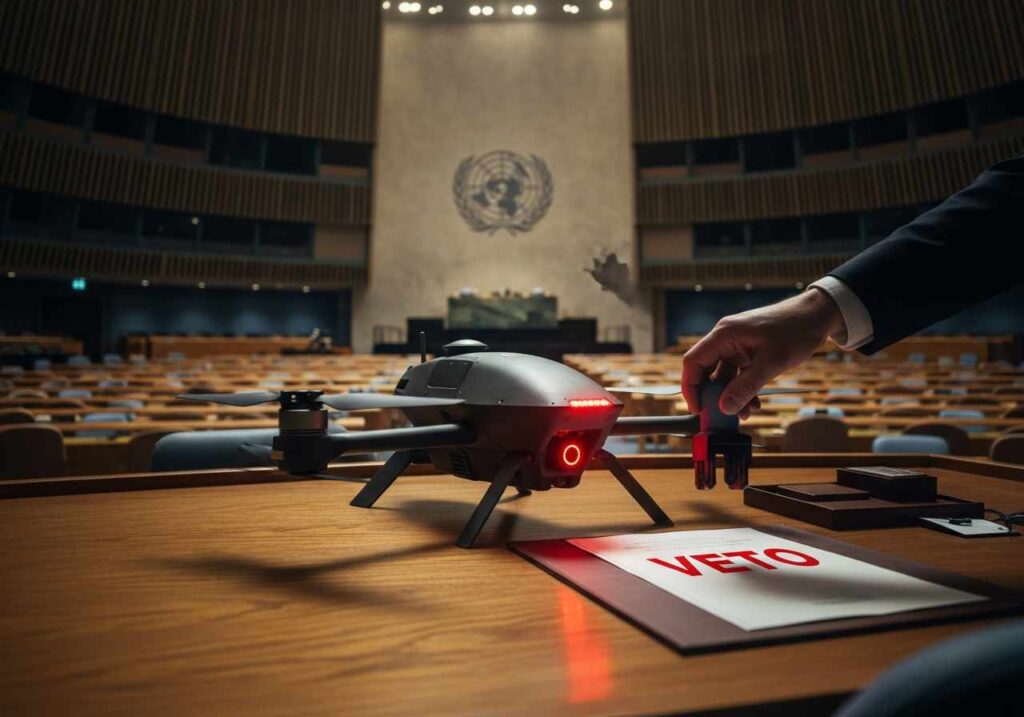
WWe are all familiar with the sci-fi films. A robot soldier in the shape of a human being gazes at his creator with cold, metal eyes. What, however, about the fact that the real danger is not a walking, talking Terminator? What happens when it is a quiet, intelligent swarm of drones which have already been developed, and which are capable of making life-and-death-decisions all on their own? This isn’t a future fantasy. It is the basic controversy of a raging world debate that is currently taking place in the UN meeting rooms, and it is quite honesty not going anywhere soon. The question that we are now urgent about is the following, are the world able to find a common ground in the control of these weapons, before they alter the very character of war?
The Stalled Diplomacy: A Political Gridlock
Since almost ten years, the diplomats have met at the UN Convention on Certain Conventional Weapons. Their goal? To speak about Lethal Autonomous Weapons Systems (LAWS). The development has been snail-like. Another meeting in 2023 also reached no result as major powers were unwilling to define the problem at all. This lack of action poses a threat of vacuum.
Key factions have emerged:
- The Pro-Ban Camp: They are headed by Austria and Brazil who insist on a legally binding treaty. They state that we have to put a moral border now.
- The Resistance: The US, Russia, and UK are against a ban. They assert that there exists enough laws to be. Another thing that they also fear is loss of a strategic advantage.
This separation is not just theatrical politics. It is a competition with the blistering speed of the AI Robotics development. Each day, when the treaty is not signed is a day of technology progress.
The Moral Minefield: An Accountability Disjuncture
Let’s cut to the chase. When a machine commits a deadly error, who is to blame? Is it the programmer, the military commander or even the algorithm itself? This is a key flaw, the so-called accountability gap. In the absence of a definite answer, we will have the problem of establishing a world in which no one is the responsible author of violence.
Besides, these systems dehumanize conflict. When only hardware and not human lives is on your side is it easy to go on strike? That would result in the corrosion of war. This destabilizing effect is the warning of the Campaign to Stop Killer Robots. They indicate that more than 100 countries are now publicly debating military AI.
We are sleep walking into a world where machines control who lives and who dies. This is not merely concerning technology, but our humanity. – A human rights watch AI Ethicist.
Speed and Scale- The Military Allure
Naturally, the military is seeing enormous worth. Human response time is a liability in a war where the hypersonic missiles are involved. Defense systems that are based on AI can respond within microseconds. Equally, a single operator may control a swarm of hundreds of intelligent robots. It is an effective force multiplier.
The appeal is clear. It minimises rapid danger to military personnel. But this temporary gratuity is a long-term temptation. We are creating systems that may take the conflict to a whole new level that man may not understand or cannot control. Efficiency logic is taking precedence over the concept of humanity.
Case Study: The Decision Making Drone
Forget the humanoid robot. The example of the real world is much more banal, and here too. Take the example of Israeli Harpy drone. It is a loitering munition, which is capable of patrolling a large distance on its own. At a button press in the middle of the mission, it is programmed to identify, hunt, and destroy certain radar targets.
This isn’t science fiction. It is a weapon system that is implemented and that is blurred. At what point do the machines take over and humans cease to have control? The Harpy demonstrates that the issue of autonomy is not something to worry about in the future. It is a present-day reality. This ranks the political stalemate even higher as alarming.
The Human Cost: A Conflict Zone at Personal Level
I have interviewed a former UN observer in Syria. He explained a new reality that was chilling. You no longer fear the enemy, he said to me. You are afraid of the dull fly buzzing in the sky. We see it is spying, studying. But one never knows who is running it, or whether anybody is. This is the new war causing psychological terror. It is a physical result of this artificial intelligence arms competition.
The Way Ahead: is Hope Still Alive?
So, what can be done? It appears that a complete treaty is far off but other avenues can be used. Political declaration is one step that is being demanded by some countries. Technology employees have come out to do walkouts over the military AI projects conducted by their companies. These are important places of pressure.
We need to focus on:
- Meaningful human control. Holding one accountable at all times.
- Transparency. It makes explainable AI a requirement so we can be able to know about its decision.
- Global norms. It would be necessary to build consensus, even in the absence of a full treaty.
The aim is not to prevent AI Robotics innovation. It’s to direct it. It should not be a case that this potent technology ought to be an enabler of mankind rather than the reverse. – A Political Economist at the UN Institute of Disarmament Research.
The Last Decision: A Border We Have to Cross
There is a time bombing on. Our diplomatic paralysis is not causing the pause in the development of autonomous weapons. We stand at a crossroads. One of the roads leads to the world where the war is fully automated, sanitized and always tempting. The other involves the hard, ugly business of making cooperation on the international level set humanity squarely in the loop.
This is the nuclear non-proliferation age of our generation. We should either decide to control this technology or it will control us. Our future and even our very humanity lies in the decision that we make today.

